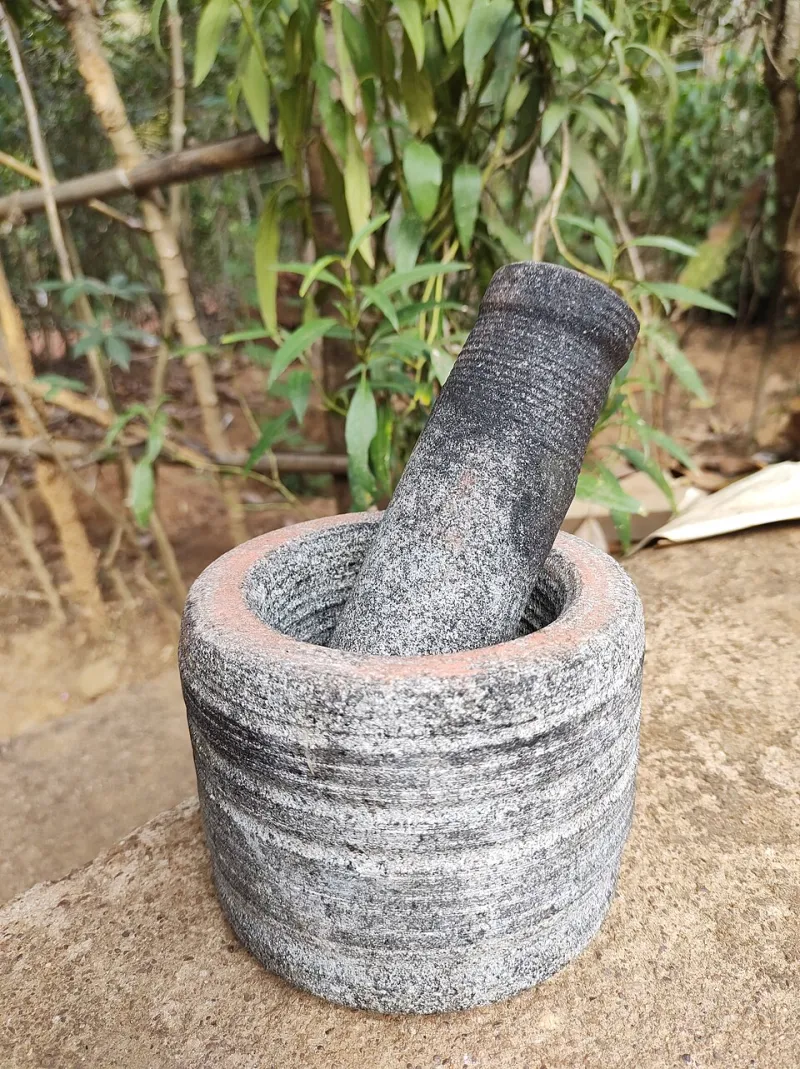
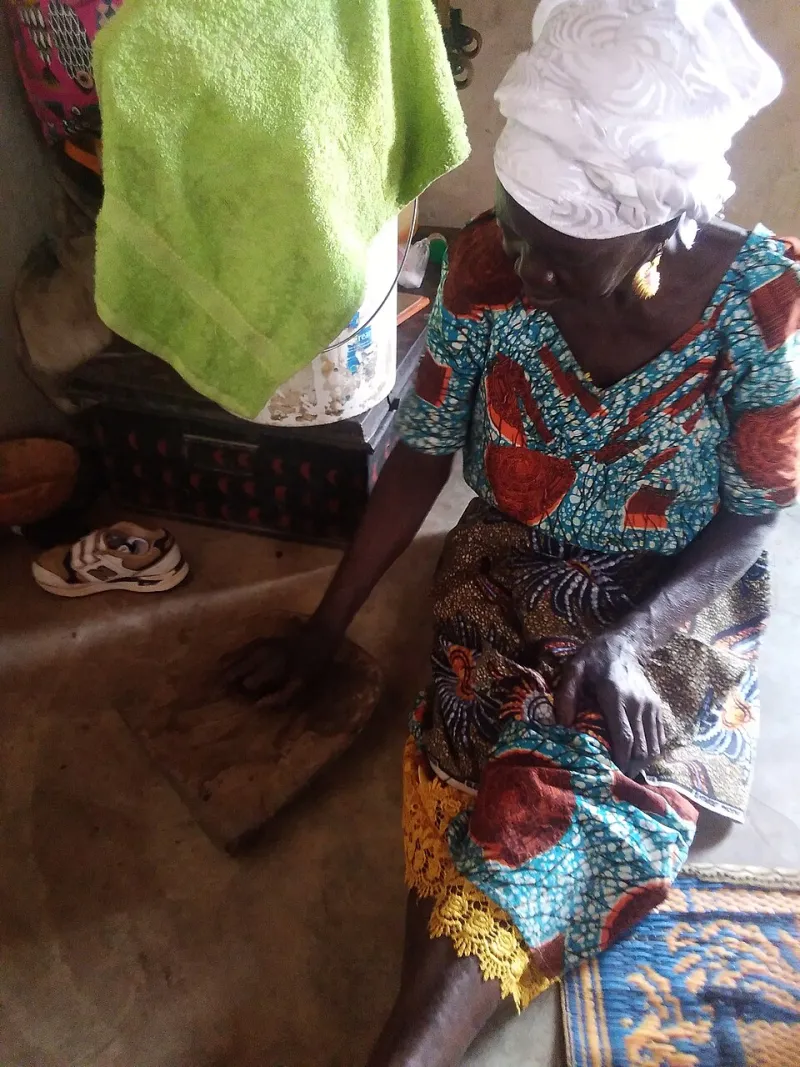
They Knew Before the Lab Did: How Ancient Grinding Rituals Predicted Modern Skincare Science
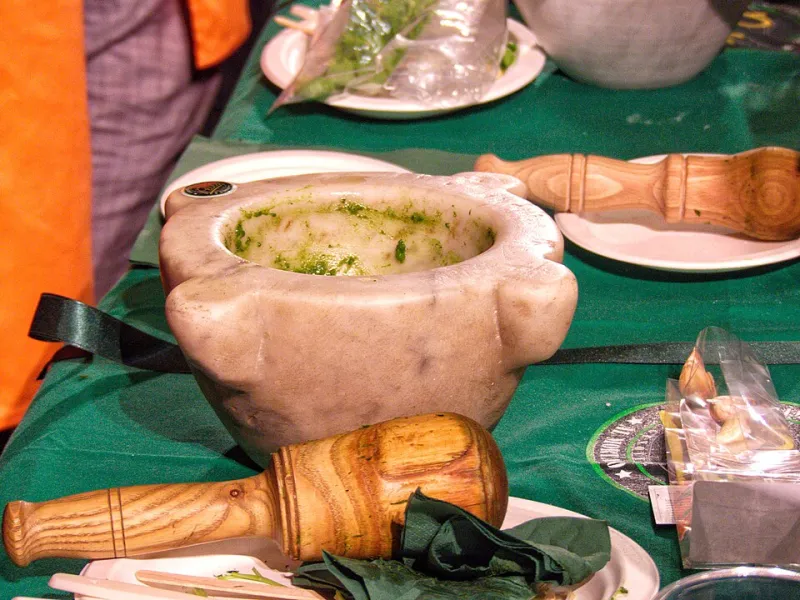
Photo: Emiros D, CC BY-SA 4.0, via Wikimedia Commons
There's a particular kind of humility that comes from realizing a 3,000-year-old practice was more sophisticated than anything your chemistry degree prepared you for. That's the position a growing number of cosmetic scientists find themselves in right now — staring at data that keeps pointing back to the mortar and pestle.
Not as a symbol. Not as aesthetic shorthand for "natural." As an actual, mechanically superior method of preparing ingredients for the skin.
The validation has been slow, peer-reviewed, and — for anyone who grew up watching a grandmother grind turmeric by hand — deeply unsurprising.
Ayurveda's Particle Size Problem (That Wasn't Actually a Problem)
In traditional Ayurvedic skincare, the preparation of herbal pastes — called lepa — followed strict protocols around grinding time, pressure, and the addition of liquid activators like rosewater or raw milk. Practitioners weren't just following ritual. They were, as it turns out, controlling particle size with remarkable precision.
Modern dermal absorption research has confirmed that particle size is one of the most critical variables in whether a topical ingredient actually penetrates the stratum corneum — the skin's outermost barrier. Ingredients ground to between 100 and 500 nanometers in diameter show significantly higher absorption rates compared to coarser preparations. Anything much larger tends to sit on the surface, doing relatively little.
Here's where it gets interesting: stone-ground preparations of turmeric — a staple in Ayurvedic lepa — consistently produce curcumin particles in that optimal absorption range. Industrial milling, which prioritizes speed and volume, frequently overshoots, producing inconsistent particle distributions that compromise efficacy. The ancient method wasn't behind the science. It was ahead of it.
Researchers at institutions studying traditional medicine formulations have noted that the slow, circular grinding motion specific to mortar-and-pestle technique generates localized heat and friction that progressively reduces particle size in a controlled way that high-speed blending simply doesn't replicate. The tool matters. The motion matters. The time spent matters.
Traditional Chinese Medicine and the Molecular Unlocking Nobody Named
Traditional Chinese Medicine has long used a preparation technique called shui fei — water levigation — in which mineral and botanical ingredients are ground with water, repeatedly, until the finest particles float to the surface and are collected. It looks almost meditative. What it actually is, from a chemistry standpoint, is a sophisticated fractionation process.
The particles collected through water levigation are not just smaller — they're selectively smaller. Denser, less bioavailable compounds sink. Lighter, more structurally active molecules stay suspended. What practitioners were collecting, without naming it as such, was a more bioavailable fraction of the original ingredient.
Pearl powder — a classic TCM skincare ingredient — prepared through water levigation contains a different molecular profile than pearl powder prepared through mechanical milling. The levigated version shows higher concentrations of conchiolin protein fragments, which are now understood to support collagen synthesis and skin barrier function. The traditional preparation didn't just preserve the ingredient. It selected for its most active components.
Western cosmetic science arrived at the concept of "active fractionation" — isolating the most efficacious molecular fractions of a raw ingredient — in the late 20th century. TCM practitioners had a working version of it centuries earlier. They just called it something else and did it by hand.
The Mediterranean Approach: Cold Grinding and Oxidation Control
In Mediterranean herbal traditions — from Greek pharmakopeia to North African beauty rituals — botanical preparations were typically ground cold, often on marble or limestone surfaces, and used immediately. This wasn't just practical. It was chemically protective.
Many of the most valuable compounds in botanicals are volatile or oxidation-sensitive. The polyphenols in olive leaf, the flavonoids in chamomile, the terpenoids in rosemary — all of them degrade rapidly when exposed to heat or oxygen during processing. Industrial cosmetic manufacturing addresses this with preservatives, antioxidant additives, and nitrogen-flush packaging. Traditional Mediterranean preparation addressed it by not introducing the problem in the first place.
Cold-stone grinding generates minimal heat. The short window between preparation and application meant minimal oxidation exposure. The result was an ingredient arriving at the skin in a chemically intact state that modern formulations often struggle to replicate, even with sophisticated stabilization technology.
This is now reflected in the rise of "cold-processed" and "fresh-formulated" skincare as premium categories in the US market. Brands are investing heavily in manufacturing processes that mimic what a stone surface and immediate use accomplished for free. The principle is identical. The ancient version just had lower overhead.
What the Convergence Actually Means
It would be easy to frame all of this as "science validates tradition" — a tidy narrative where modern research gives ancient practices their gold star. But that framing undersells what's actually happening.
These weren't lucky guesses. Ayurvedic practitioners observed outcomes over generations and refined their methods based on what worked on real skin. TCM formulations were adjusted, documented, and passed down through empirical iteration spanning centuries. Mediterranean herbalists knew which preparations produced visible results and which didn't. They were running longitudinal studies. They just didn't call them that.
What modern science is doing isn't validating tradition so much as translating it — providing a molecular vocabulary for mechanisms that were already understood experientially. The grinding technique was always doing what it was doing. We just now have the instruments to see why.
For skincare consumers, that distinction matters. An ingredient prepared through methods that have been empirically refined over millennia, and that modern research has since confirmed as mechanically optimal, isn't a nostalgic choice. It's arguably a more evidence-based one than reaching for something formulated last year with ingredients that haven't had time to accumulate any meaningful track record at all.
The Pestle Isn't a Prop
At Pestle & Mortar Cosmetics, the mortar and pestle isn't branding. It's a position. It represents a specific claim: that how an ingredient is prepared changes what it does, and that some preparation methods carry thousands of years of refinement that no amount of industrial scaling can shortcut.
The science is increasingly on that side of the argument. Particle size, molecular bioavailability, oxidation integrity, active fractionation — every one of these modern skincare priorities has a traditional preparation practice that got there first.
The lab is catching up to the kitchen. And the kitchen, it turns out, always had better technique.