Pressure Points: The Surprising Science of How Friction Makes Botanicals Work Harder for Your Skin
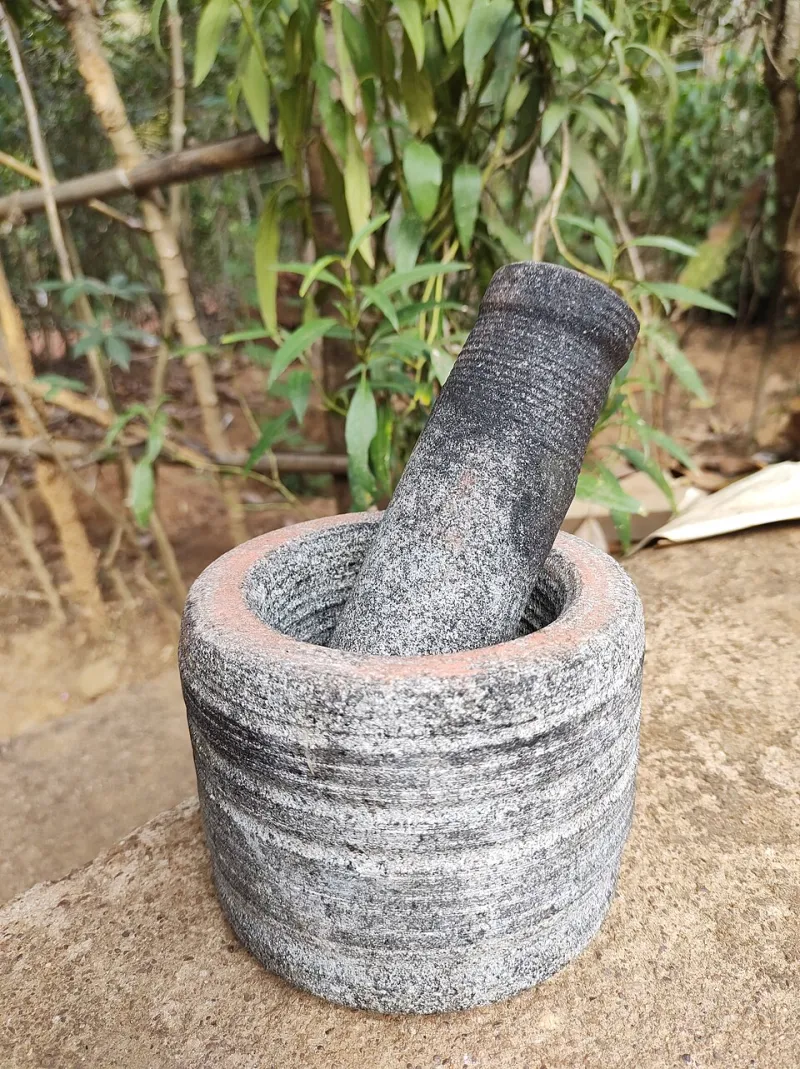
Photo: Saankav, CC BY-SA 4.0, via Wikimedia Commons
There's a reason the mortar and pestle has survived thousands of years of human ingenuity. We've invented blenders, centrifuges, ultrasonic emulsifiers, and industrial milling machines — and yet the ancient image of stone grinding against stone still shows up in apothecaries, Ayurvedic clinics, and increasingly, in the language of modern cosmetic chemistry. That's not nostalgia. That's a clue.
The secret isn't in the tool itself. It's in what friction actually does to a botanical at the molecular level — and why that matters enormously for what eventually reaches your skin.
What Happens When You Grind Something Down
Most of us think about skincare ingredients in terms of what they are: this oil has linoleic acid, that root has antioxidants, this seed is rich in vitamin E. We spend a lot of time focused on the ingredient list and not nearly enough on what happens to those ingredients before they reach the jar.
When plant material is ground — really ground, with pressure and friction — the cell walls rupture. And that rupture is where things get interesting.
Plant cells are encased in rigid walls made of cellulose and pectin. These walls protect the plant's bioactive compounds during its lifetime, but they also act as a barrier when that plant material is used in skincare. Many of the most potent phytochemicals — flavonoids, phenolic acids, volatile aromatic compounds — are locked inside those cells. Without mechanical disruption, they stay locked.
Friction-based grinding doesn't just break those walls open. It also generates localized heat and pressure that can trigger what chemists call mechanochemical reactions — molecular changes caused by mechanical force rather than heat or chemical catalysts. Some of these reactions increase solubility, meaning compounds that wouldn't ordinarily dissolve into a carrier oil or water base suddenly can. Others reduce particle size to a degree that dramatically improves how deeply an ingredient can penetrate the outer layers of skin.
The Passive vs. Active Preparation Problem
Here's the part that doesn't get talked about enough in mainstream beauty: most mass-produced skincare starts with pre-processed ingredients. Botanical extracts arrive at manufacturing facilities already standardized, already stabilized, often already diluted into a carrier. The grinding happened somewhere else, by someone else, under conditions optimized for consistency and shelf life — not for potency.
Stability and potency are not the same thing. In fact, they're often in direct tension.
The same oxidation processes that make freshly ground turmeric or black seed so biologically active are exactly what manufacturers try to suppress to extend a product's shelf life. Antioxidant-rich botanicals are particularly vulnerable here — their activity comes from their reactivity, and reactive compounds don't sit quietly in a bottle for eighteen months.
Handcrafted preparation, by contrast, is active preparation. The friction of grinding doesn't just open cell walls — it initiates a kind of biological readiness. Enzymes that were compartmentalized within the plant's cellular structure get released and begin interacting with other compounds. Essential oils volatilize slightly, becoming more diffusible. Polyphenols that were bound to cell wall fibers come free.
You're not just breaking something apart. You're waking it up.
Why Particle Size Is a Bigger Deal Than Anyone Told You
Skin penetration is largely a size game. The outermost layer of skin — the stratum corneum — is a remarkably effective barrier. It's designed to keep things out, and it's good at its job. For an ingredient to actually reach the living cells beneath it, it needs to be small enough to pass through.
This is why the cosmetics industry has invested heavily in nanotechnology — reducing active ingredients to nano-sized particles that slip through the skin barrier more efficiently. But here's what's interesting: careful, sustained grinding achieves something similar through entirely natural means.
Studies on traditionally milled spices and herbs have shown that stone grinding produces a broader particle size distribution than industrial processing — meaning you get a range of sizes, some of which fall into ranges that are genuinely more bioavailable. The irregular fracture patterns created by stone-on-stone grinding also expose more surface area per particle compared to the uniform cuts made by industrial blades, which increases the rate at which active compounds can be absorbed into a carrier.
This isn't a minor technical footnote. It's the difference between an ingredient sitting on top of your skin and one that actually gets to work.
The Ritual Has Always Been Part of the Formula
Ancient beauty traditions — whether we're talking about Unani medicine in the Middle East, the elaborate cosmetic preparations of the Tang Dynasty, or the botanical compounding practices of Indigenous North American healers — all shared an understanding that preparation was inseparable from efficacy. You didn't just use the plant. You worked with it.
That work — the grinding, the pressing, the slow incorporation — wasn't ceremonial filler. It was functional. These traditions didn't have access to bioavailability studies or mechanochemistry research, but they had something equally valuable: generations of observed results. They knew that the turmeric paste prepared fresh in a stone bowl behaved differently on skin than the same turmeric left to sit. They knew that freshly crushed rose petals did something that dried, powdered rose extract didn't.
Modern science is finally catching up with what those traditions encoded empirically. And what it's finding is that friction — real, physical, mechanical friction — is a preparation step, not a stylistic one.
What This Means for How You Think About Your Skincare
You don't need to grind your own ingredients to benefit from this science (though if you're into it, we're absolutely not going to stop you). What you can do is start asking better questions about the products you use.
Where did these botanical ingredients come from in their journey to this formula? Were they processed for longevity or for potency? Is the manufacturer working with active, freshly prepared plant material, or with standardized extracts designed to behave predictably on a production line?
The answers will tell you a lot.
At Pestle & Mortar Cosmetics, the name isn't decorative. It's a declaration of intent — a commitment to the idea that how an ingredient is prepared is as important as what that ingredient is. The friction matters. The pressure matters. The moment of grinding, when a botanical's cellular architecture breaks open and its chemistry becomes available, is where skincare either starts working or doesn't.
Every jar we make begins with that moment. And now you know why.