Crushed, Not Blended: The Real Reason Texture Matters More Than You Think
Photo: Unknown, CC BY-SA 4.0, via Wikimedia Commons
When you picture someone grinding herbs into a paste — slow, circular pressure, the smell of botanicals blooming open — it probably reads as quaint. Nostalgic, even. Something your grandmother might have done in a kitchen that smelled like dried lavender and cedar.
But here's the thing: that image isn't just aesthetically pleasing. It's actually a more sophisticated form of processing than the industrial high-speed blending that dominates modern cosmetic manufacturing. And cosmetic chemists are starting to say so out loud.
The difference between these two methods isn't about vibe. It's about physics, heat, and the fragility of the compounds your skin actually needs.
What High-Speed Blending Does to Your Botanicals
Industrial blenders and mill processors work fast — that's the point. In a large-scale manufacturing setting, speed means volume, and volume means cost efficiency. But speed generates something that most product labels will never mention: heat.
High-speed mechanical processing creates friction at a rate that raises the temperature of the material being processed, often significantly. For a lot of botanical ingredients, this is a problem. Many of the most valuable plant compounds — polyphenols, volatile terpenes, heat-sensitive antioxidants like vitamin C derivatives — begin to degrade at temperatures well below what most of us would even consider warm. Some start breaking down around 104°F. Others are even more delicate.
Beyond heat, high-speed blending also introduces oxidation. When plant cell walls rupture rapidly and the contents are exposed to air at high velocity, oxidation accelerates. The very compounds responsible for brightening, soothing, and protecting your skin start converting into less active forms before the product ever reaches a jar.
There's also the matter of particle consistency. Industrial processing tends to produce either uniformly fine particles (through milling) or inconsistently shredded material (through blending). Neither of these outcomes is ideal for skin absorption.
The Mechanical Logic of the Mortar
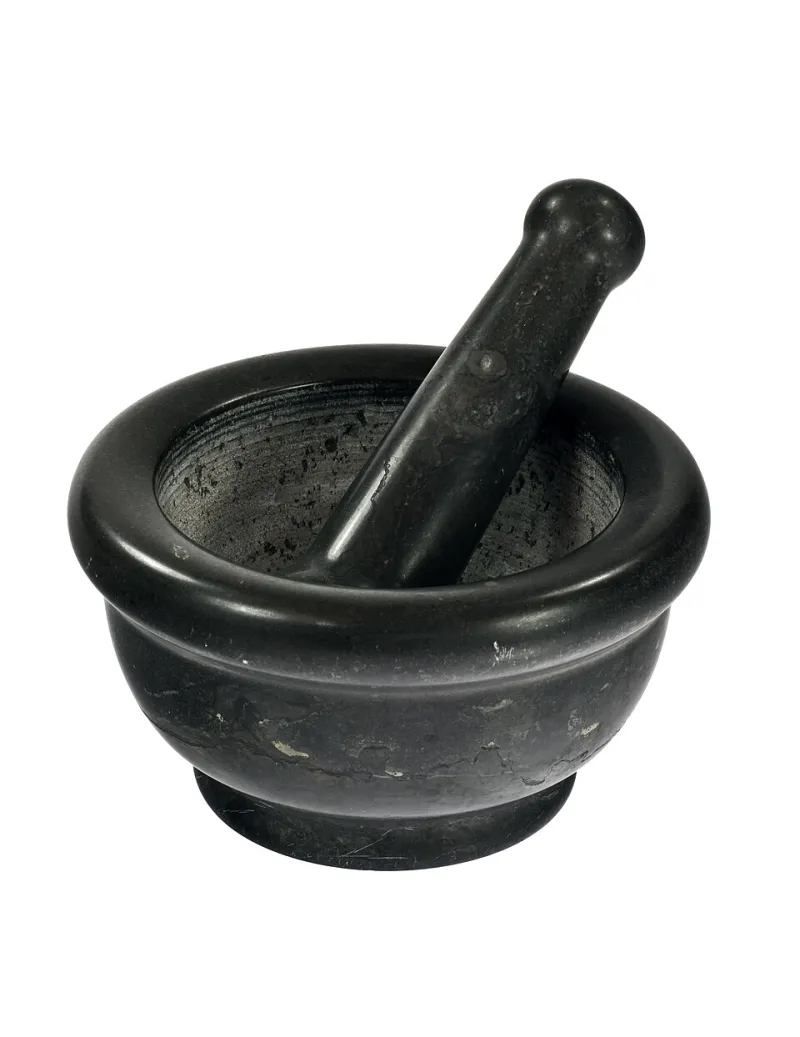
Hand-grinding works differently at every stage. The pressure applied through a mortar and pestle is compressive and shearing rather than percussive or slicing. Instead of cell walls being torn open chaotically, they're gradually compressed and ruptured in a way that releases cellular contents more completely — and more gently.
This matters because intact plant cells contain their active compounds in compartments. Essential oils, flavonoids, and fatty acids are often housed in specific cellular structures. When those structures are broken slowly, the compounds are released into the surrounding medium in a way that preserves their molecular integrity. When they're shattered at high speed, that integrity is compromised.
Cosmetic chemistry research on particle size distribution has shown that hand-ground botanical pastes tend to produce irregular, varied particle sizes — and this turns out to be an advantage for skin absorption. Your skin's surface isn't uniform. It has pores of different sizes, texture variations, and micro-channels through which ingredients travel. A range of particle sizes means more surface area contact and better integration across the skin's topography.
Uniform micro-milled particles, by contrast, can actually form a kind of film on the skin's surface rather than penetrating it. They sit on top of the barrier rather than working with it.
Temperature Is the Variable Nobody Talks About
Let's get specific about heat for a second, because it's the piece of this conversation that tends to get skipped.
Research into heat degradation of plant bioactives has found that compounds like eugenol (found in clove and basil), linalool (lavender), and catechins (green tea) begin measurable degradation at processing temperatures that industrial equipment routinely exceeds. In contrast, hand-grinding — even vigorous hand-grinding — rarely elevates material temperature by more than a few degrees.
For antioxidant-rich ingredients like rosehip, turmeric, and sea buckthorn, this temperature gap is the difference between a product that delivers measurable free-radical protection and one that primarily delivers color and fragrance. The antioxidant capacity of these botanicals in a hand-processed formula versus an industrially processed one can differ by a margin that shows up in actual skin outcomes.
This is part of why so many people report that artisanal skincare products feel different on the skin — not just texturally, but in terms of how their skin actually responds. It's not placebo. The chemistry is different because the processing was different.
What This Means for Absorption
Absorption is ultimately the metric that matters most. A product packed with potent ingredients that can't penetrate the skin barrier is just expensive decoration.
Hand-ground formulations tend to retain more of the natural emulsifying compounds present in plants — phospholipids, saponins, and certain waxes that help ingredients cross the skin barrier. These compounds are often casualties of high-heat, high-speed processing. When they survive intact, they act as natural delivery agents, helping the formula interact with your skin's lipid layers rather than sitting above them.
The result is a different absorption experience — one that feels like the product is being drawn into the skin rather than sitting on top of it. If you've ever used a well-made artisanal face oil or botanical mask and noticed how quickly it seems to absorb compared to a department store equivalent, this is likely why.
Artisanal Isn't a Aesthetic — It's a Method
The beauty industry loves the word "artisanal." It's been stretched to cover everything from mass-produced products with kraft paper labels to genuinely handcrafted formulations. The distinction matters.
True artisanal processing — the kind that actually preserves ingredient integrity — requires slower preparation, smaller batches, and a willingness to prioritize efficacy over efficiency. That's not a romantic choice. It's a scientific one.
At Pestle & Mortar Cosmetics, the name isn't decorative. It's a commitment to the idea that how ingredients are prepared is inseparable from what those ingredients can do. The ancient healers who ground their botanicals by hand weren't doing it because they lacked better tools. They were doing it because it worked. And now we have the science to explain exactly why.