What the Stone Tells You: Using the Mortar as a Skincare Diagnostic Tool
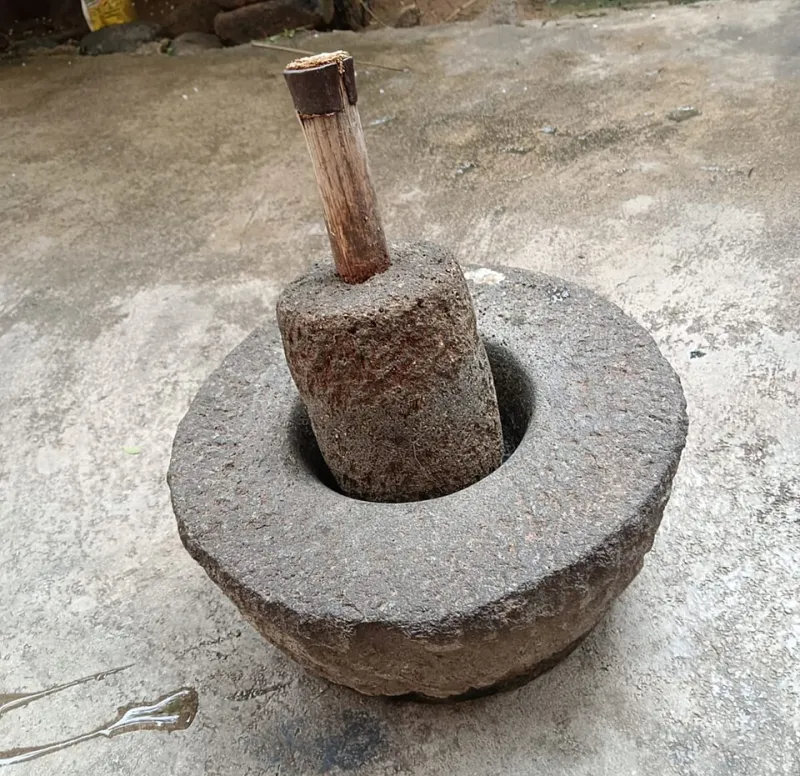
Photo: Prabhavathi anaka, CC BY-SA 4.0, via Wikimedia Commons
There's a moment, about thirty seconds into grinding dried calendula petals, when the color shifts. The pale yellow deepens. A faint, almost honeyed warmth rises from the bowl. The resistance under the pestle softens, then changes again — becomes almost waxy. If you're paying attention, that moment tells you something. Not just about the calendula, but about what your skin might actually be asking for right now.
This is the part of skincare that a product label can't give you. And it's the part that ancient apothecaries built their entire practice around.
The Hands Knew First
For most of recorded history, the people responsible for formulating skin treatments weren't reading clinical abstracts — they were grinding. The mortar and pestle wasn't just a tool for combining ingredients; it was an instrument of observation. The texture of a ground herb, the oil it released, the color it produced, the scent that bloomed under pressure — all of that was diagnostic data. It told the practitioner what was present in the plant, how potent it was, and how it might interact with a particular skin condition.
Ayurvedic practitioners in ancient India, herbalists across medieval Europe, apothecaries in pre-colonial North America — they all worked this way. Formulations weren't standardized. They were read, then assembled, based on what the ingredients themselves communicated during preparation.
We've largely walked away from that. Modern skincare asks us to trust the label. And in many ways, that's fine — science has given us a lot. But somewhere in the trade-off, a lot of us lost the ability to actually feel what our skin needs, because we stopped being present in the process of making anything for it.
Resistance as Information
Here's something worth trying. Take two different dried botanicals — say, rose hip and green tea — and grind them separately in a mortar. Pay attention to what each one does under pressure.
Rose hip resists first, then gives way almost grudgingly, releasing a faint fatty residue that clings slightly to the stone. Green tea breaks down faster, almost eagerly, producing a dry, fine powder with a sharp, tannic edge. These aren't just textural quirks — they're telling you about the ingredient's composition. The resistance and oiliness of rose hip reflects its fatty acid content, the same lipids that make it so effective for dry, barrier-compromised skin. The dry, quick breakdown of green tea signals high tannin and polyphenol density — astringent, tightening, antioxidant-rich.
If your skin is tight and flaky, which one do you reach for? The answer becomes obvious when your hands have actually felt the difference, in a way that reading a blog post about it never quite replicates.
This is what skincare literacy through preparation actually means. You're not just mixing ingredients — you're building a vocabulary.
Color as a Conversation
Watch what happens to turmeric when you grind it fresh versus when you grind it from a dried, pre-packaged spice that's been sitting in a cabinet for two years. The color difference is dramatic. Fresh-ground turmeric is almost aggressively orange — vivid, almost electric. Old turmeric produces a muted, dusty yellow. That color tells you about curcumin concentration. More color, more potency. Less color, less therapeutic value.
The same principle applies across ingredients. Deeply pigmented botanicals — hibiscus, butterfly pea flower, matcha — signal antioxidant richness through their color intensity. When you're grinding and you notice the color is dull or washed out, that's information. That batch may not be worth including in a formulation you're counting on to do something meaningful for your skin.
Ancient apothecaries used this color-reading instinctively. They knew which shade of a plant indicated peak harvest, which indicated age, which indicated poor growing conditions. We can still do this. We just have to slow down enough to look.
Scent as Potency Check
The aromatic compounds in botanical ingredients — terpenes, volatile oils, aromatic aldehydes — are among the most bioactive components they contain. They're also among the most fragile. Heat, oxidation, and time degrade them quickly.
When you grind a fresh herb or dried flower and the scent blooms strongly, that's a sign the volatile compounds are still intact. When the scent is faint or flat, something's been lost — and often, so has a portion of the ingredient's therapeutic value.
This is a check that takes about ten seconds and requires no equipment beyond your nose. It's one of the most reliable potency tests available, and it's one that every ancient herbalist used without even thinking about it. Lavender that doesn't smell strongly of lavender when ground probably isn't going to calm inflammation the way it should. Frankincense that's lost its resinous bite has likely lost much of its boswellic acid activity too.
Your nose isn't infallible. But it's a faster, more accessible first-pass quality check than most of us give it credit for.
Reading Your Skin Through the Process
Here's the part that might surprise you. The diagnostic value of mortar-and-pestle preparation isn't only about the ingredients — it's also about what you notice in yourself while you're doing it.
When you slow down enough to grind something by hand, you tend to slow down enough to actually look at your skin. You notice the texture around your nose more clearly. You register whether your cheeks feel tight or comfortable. You pay attention to whether a particular scent makes you feel calm or slightly irritated. These are signals. They're the same signals that ancient apothecaries were trained to observe in the people they were formulating for.
Modern skincare marketing has, somewhat perversely, made us less aware of our skin by flooding us with diagnoses. You're oily. You're dry. You're combination. You're aging. These categories are blunt instruments. What the mortar-and-pestle ritual teaches you, over time, is that your skin is more dynamic and specific than any fixed category allows for — and that what it needs on a humid July morning in Atlanta is genuinely different from what it needs on a dry December afternoon in Denver.
Bringing It Into Your Routine
You don't need to overhaul your entire skincare cabinet to start practicing this. Start small. Pick one ingredient you're already using — maybe an oat-based mask, a chamomile toner, a rosehip facial oil — and trace it back. Buy the raw form. Grind a small amount by hand before your next application. Spend two minutes noticing what happens under the pestle.
Do this a few times over a couple of weeks, and something starts to shift. You begin to develop what we'd call ingredient intuition — a felt sense of what a botanical is and what it can offer, rather than a reliance on whatever the packaging tells you.
That's the philosophy behind everything we do at Pestle & Mortar Cosmetics. The tools in our name aren't decorative. They're a reminder that the most sophisticated skincare knowledge isn't always found in a lab. Sometimes it's found in the moment when stone meets plant, and you're paying close enough attention to hear what that tells you.
Ancient wisdom didn't come with a QR code. But it's still here, available in the weight of a pestle, the resistance of a root, and the scent that rises when something real is being made.